August 13, 2025
Over the years, I have kept a running list of books I should have read long ago but have not yet either found the time, the will or, the enthusiasm to undertake an effort which was once simpler. I suspect that similarly, there are great number of things which we all defer to some future place in time – in the same way that we defer so many other things to others in areas of our lives which we might not prefer to acknowledge.
This is the essence of one of the ideas or dilemmas which settled into my mind as I picked up and read a work I had been planning to get to for many years, the essay on Civil Disobedience by Henry David Thoreau. I am ashamed to admit that while I had started – arguably, Thoreau’s more famous work Walden, a handful of times – there was at the time in which I began to read the work, a noise in my life which distracted me from continuing through and finishing it.
There is a calm and a singular essence to the writing of Thoreau which I have encountered in pieces over time which is perhaps even more extreme and extraordinary in its sense of conveying solitude that I have not observed anywhere else.
Before I share my thoughts on Thoreau’s style of writing, which I find particularly fascinating and profoundly effective. I feel compelled to share how in my own writing, I have slowly and incrementally realized something about the nature of efficacy and how I might improve my writing as it relates to forming a compact or condensed style. I have observed how some of the most powerful, effective, influential and dare I say, eternal works of writing are sometimes the shortest and if they are not, they are so potent that they are almost many books or, many works synthesized into one.
I have encountered many short works which contain power and force which are almost even more commanding and prevailing due to their compact length. These thoughts even remind me of a statement of Poe’s – perhaps it was in his Philosophy of Composition – wherein he wrote of how a length of a work should be based on whether it may be read in one sitting so that the whole effect of the work could be digested at once and remembered more immediately – or something to this effect. This sentiment or, intention has always remained with me though I perhaps have not always applied its meaning into practice.
Machiavelli’s The Prince, Voltaire’s Candide, Hesse’s Demian¸ Hemingway’s The Old Man and the Sea and countless others I cannot recount at this time are works of great power. Thoreau’s Walden of course could be qualified here as would works of poetry and even the books of the Bible or, many world scriptures, if we take them to be individual books in a much larger library of collected writings – are perhaps the most condensed, the most compact and potent writing our collective species have remembered and sustained to extract lasting value from. The Constitution, The Declaration of Independence and many other key documents – all represent a potency of thought although appearing short – imply a purity of thinking and ideas – which pass as an unbroken beam of light through the decades and centuries which proceed them and are monuments of writing and human thought.
I have sought in my writing to find a way to reduce my thinking – down into its most potent mode of delivery. For I have learned that writing is essentially just thinking bound within a craft or, style which allows thoughts and ideas to be presentable and acceptable. The truth is unpleasant and perhaps a skilled writer is one who can deliver the truth we push away from our view – back into a frame which helps us understands its nutritional value – so to speak.
For this reason, I contemplated what work I might read and absorb, which might challenge my mind to understand the power of a condensed style of writing and just before I considered I might try at last to read Walden, the essay of Thoreau’s on Freedom titled, Civil Disobedience preceded his other works in the volume of his writings in my possession, captured my attention. It had always been a curiosity to me what this work represented and how often it is referenced – perhaps even just in the meaning of its title – a reference to a fundamental right available to all individuals and citizens in the world. So, I decided I would endeavor to read it through – considering perhaps that I might read Walden after.
Upon reading Thoreau’s essay, I was struck by its honesty, frankness and direct language. It is a work about the virtues and values of individual freedom and most importantly about the infallible value of human Conscience.
The work concerns itself with the simplicity of accepting and understanding one’s own human rights and how practical it is to resist the impositions of others – particularly from the State – onto one’s own space and freedoms. If I may be so bold to remark that while the work is short, its density and gravity of thought is not easily readable – it is readable in the sense that if one remains engaged with the author’s conscience and his essential concerns it may be followed – but the concerns and the commentary within is sufficiently rich and weighted, perhaps a sign of the times and of writing of the period that its weight may feel to be the equivalent of a more flowing and lyrical work which if perhaps a hundred pages longer – itself could even feel to be shorter or, even simpler to read.
I suspect it may be that there is a deep seriousness to the subject matter and the author is perhaps pouring his soul into the truly unsettling problem of the over-reach of Government and the dangers of brute force as it relates to national security as a means to control and expand the powers of the state that the essay feels like a sermon, a speech, a plea. It feels as some cannon ball which is difficult to lift and lodge in its place in the cannon –but once laborious task of situating this dense and powerful object is accomplished and the fuse lit – it hits its near impossible target in the distance – and the effect is felt more intensely. In much the same way as an assault by conscience on the egos, wills and delusions of materiality in our physical world may have if delivered in the purest way possible.
Thoreau makes it clear throughout the work that he is against Slavery as well as the Mexican American War of the time – it is apparent that he feels both acts to be terrible evils which makes the country deeply hypocritical as a seemingly free nation. In other words, a government representing freedom – enslaving and imprisoning its own populace and imposing itself onto other nations is unjust.
The author is not quiet about a what he argues are deep hypocrisies in the present system of governance – namely, unnecessary taxation, false virtue1, the blindness of materiality2, how voting is not a true action for change3, the power of one’s own conscience4, the error of governments using fear to control its populace5 and even references eastern philosophy6-7 in making his arguments.
The idea that the piece was originally titled, Resistance to Civil Government implies its clear message and I might argue that the title, Civil Disobedience has a greater philosophical implication. An implication of the universality of the human condition.
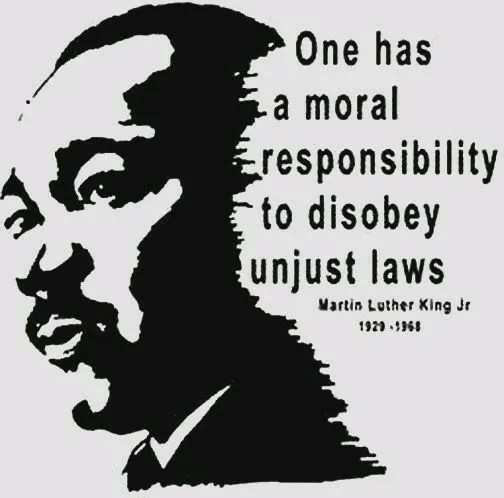
According to Thoreau, the act of rebellion isn’t something to be punished – it is simply a way of living or, of breathing – and the conscience will often find itself at odds with the mob and large groups of people inevitably. I found these themes to be deeply relevant to our modern societies today where the conscience seems lost, the language of power and control so mass produced and manufactured into a science and the senses of personal virtue, privacy, self-determination and a healthy refusal (within reason) to conform to an unjust system have never been more critical to understand and embrace.
I wrote earlier in this essay about how we all tend to defer what is most important for us to undertake ourselves to others or, even to ourselves at some later point in time. Through this powerful work, it is understood how deferring excessive and unnecessary power to others and ultimately to the state leads to greater injustice in society. The government and the individual should be as peers with one another – as neighbors – and one should not take more than is necessary from each.
There is truth clearly stated and profoundly embedded into a work which could easily have been hundreds of pages longer and perhaps if it were – it might not pack as powerful of a punch and even trouble and stir the soul in the way that the work does as it stands.
Perhaps the truest messages, writings and communications are the most concise, the simplest and in their own way pure – and justly stated.
Perhaps I learned a thing or, two about the economy of style while reading this work – I believe I did – and while my mind and my writing have tended to wander and flow at times – as if writing into some endless journal with no end. The idea that I might benefit from learning how to stop short and resist vein or, presumptuous curiosities and conjectures and order my mind to accept and communicate what is true and most simple – even if in doing so I may disobey an intended format or, guideline – it would hopefully be within civil means and perhaps in the hope that the clarity of my conscience remains preserved and my message clear, so that it may remain ever-visible against the dry and inevitable dust of time.
Selections and References
- On False Virtue:
“It is easier to deal with the real possessor of a thing than with the temporary guardian of it.” - On False Virtue as it relates to Materiality:
“Absolutely speaking, the more money, the less virtue; for money comes between a man and his objects and obtains them for him; many questions which he would otherwise be taxed to answer; while the only new question it puts is the hard but superfluous one, how to spend it.” - Regarding how Voting itself is not enough:
“A wise man will not leave the right to the mercy of chance, nor wish it to prevail through the power of the majority. There is but little virtue in the actions of the masses of men.” - The essence of Rebellion and Civil Disobedience & The Power of Conscience:
“When the subject has refused allegiance, and the officer has resigned his office, then the revolution is accomplished. But even suppose blood should flow. Is there not a sort of blood shed when the conscience is wounded? Through this would a man’s real manhood and immortality flow out, and he bleeds to an everlasting death. I see this blood flowing now.” - Brute Force
“Thus, the State never intentionally confronts a man’s sense, intellectual or moral, but only his body, his senses. It is not armed with superior wit or honesty, but with superior physical strength. I was not born to be forced. I will breathe after my own fashion” - Quoting Confucious:
“If a state is governed by the principles of reason, poverty and misery are subjects of shame; if a state is not governed by the principles of reason, riches and honors are the subjects of shame.” - On the True Path toward Freedom:
“The progress from an absolute to a limited monarchy, from a limited monarchy to a democracy, is a progress toward a true respect of the individual. Even the Chinese philosopher was wise enough to regard the individual as the basis of the empire”
 The Chain